
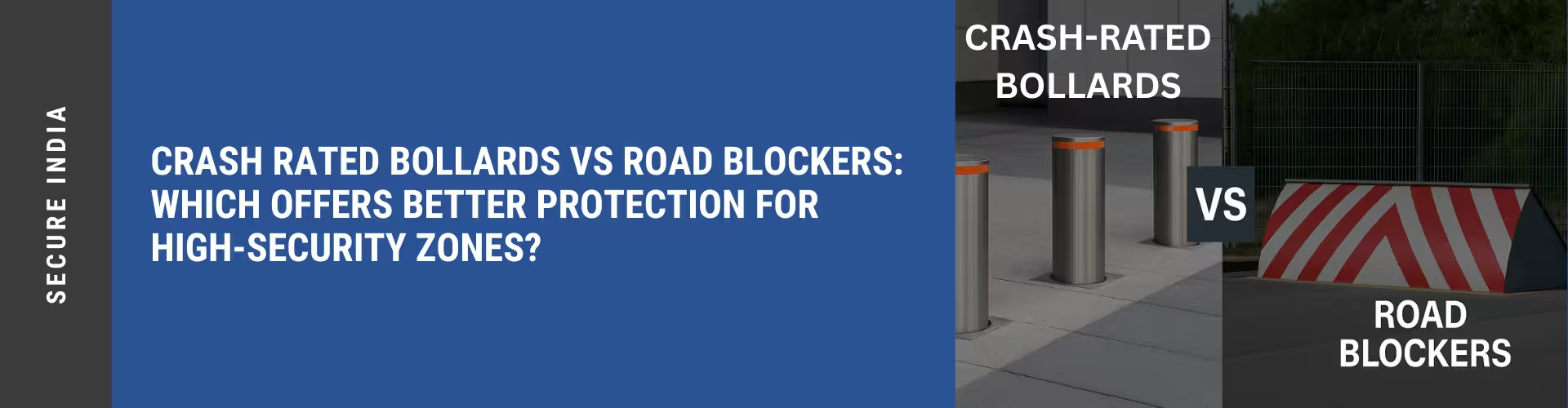
Crash Rated Bollards vs Road Blockers: Which Security Solution Is Right for Your Project?
Choosing between Crash Rated Bollards and Road Blockers is one of the most important decisions when designing a Hostile Vehicle Mitigation (HVM) system. While both are engineered to stop hostile vehicles, their applications, installation requirements, security capabilities and operational characteristics are very different.
Quick Answer
Crash Rated Bollards are best suited for protecting pedestrians, building entrances, public spaces and critical assets while allowing controlled pedestrian movement. They are commonly specified around airports, embassies, corporate headquarters, government buildings and commercial developments.
Road Blockers are designed to completely block vehicle lanes and provide the highest level of vehicle stopping capability. They are typically installed at military facilities, airports, data centres, power plants and other high-security locations where complete vehicle denial is required.
The right choice depends on your threat assessment, traffic flow, available installation space, required security level and compliance with international standards such as ASTM F2656, PAS 68, IWA 14-1 and ISO 22343.
Key Takeaways
- Crash Rated Bollards protect buildings, pedestrians and public spaces.
- Road Blockers secure complete vehicle lanes.
- Bollards provide better architectural integration.
- Road Blockers deliver higher vehicle stopping capability.
- Both solutions integrate with RFID, ANPR, biometric access control and security management systems.
- Selection should always be based on a professional security risk assessment.
Understanding Hostile Vehicle Mitigation (HVM)
Modern organisations face increasing risks from unauthorised vehicle access, vehicle-borne threats and perimeter security breaches. As a result, Hostile Vehicle Mitigation (HVM) has become an essential component of physical security strategies for airports, government buildings, defence facilities, corporate headquarters, financial institutions and critical infrastructure.
Among the most widely specified HVM products are Crash Rated Bollards and Road Blockers. Although both systems are designed to stop hostile vehicles, they serve different operational purposes and should never be considered interchangeable without evaluating the specific security requirements of the project.
Crash Rated Bollards create protective perimeters around buildings and pedestrian areas while maintaining an open architectural appearance. Road Blockers, on the other hand, provide complete lane closure and are designed to stop even heavy vehicles attempting forced entry through controlled vehicle access points.
This guide compares both systems from a consultant's perspective, covering security performance, international certifications, installation requirements, maintenance considerations, lifecycle costs and the most appropriate applications for each solution.
- Security Consultants
- Architects
- PMC Consultants
- Civil Engineers
- Government Procurement Teams
- Facility Managers
- EPC Contractors
- Critical Infrastructure Planners
What Are Crash Rated Bollards?
Crash Rated Bollards are high-security Hostile Vehicle Mitigation (HVM) systems specifically engineered to stop unauthorised or hostile vehicles before they reach people, buildings or critical infrastructure. Unlike decorative or traffic bollards, these security barriers are independently crash tested against internationally recognised standards such as ASTM F2656, PAS 68 and IWA 14-1.
Their primary objective is not simply controlling vehicle movement but mitigating deliberate vehicle attacks while maintaining pedestrian accessibility and the architectural appearance of the site. Crash Rated Bollards are widely specified for airports, embassies, data centres, government buildings, defence facilities, corporate headquarters and other critical infrastructure projects where hostile vehicle threats must be considered.
Crash Rated Bollards are certified vehicle security barriers designed to stop an impacting vehicle at a specified speed and weight, as verified through independent crash testing.
How Crash Rated Bollards Work
Crash Rated Bollards are installed in reinforced concrete foundations engineered to absorb and transfer the enormous impact energy generated during a vehicle collision. When a hostile vehicle strikes the bollard, the energy is distributed through the bollard structure and its foundation, preventing the vehicle from penetrating the protected area.
Unlike standard parking bollards, certified HVM bollards undergo controlled crash testing using vehicles travelling at defined speeds and weights. Only products that successfully meet these test criteria receive recognised crash ratings.
Common Types of Crash Rated Bollards
| Type | Best For | Main Benefit |
|---|---|---|
| Fixed Bollards | Permanent Perimeter Protection | Maximum Security |
| Automatic Bollards | Controlled Vehicle Entry | Security + Convenience |
| Semi-Automatic Bollards | Occasional Vehicle Access | No Electrical Power Required |
| Removable Bollards | Temporary Access Routes | Operational Flexibility |
Where Are Crash Rated Bollards Used?
- Government Buildings
- Embassies & Diplomatic Missions
- Airports & Aviation Facilities
- Military & Defence Installations
- Data Centres
- Power Plants & Utilities
- Corporate Headquarters
- Commercial Buildings
- Financial Institutions
- Public Spaces
Advantages of Crash Rated Bollards
- Certified protection against hostile vehicle attacks.
- Maintains pedestrian movement without obstructing walkways.
- Available in fixed, automatic and removable configurations.
- Can integrate with Access Control Systems, RFID, ANPR and security management platforms.
- Minimal visual impact compared to larger vehicle barriers.
- Suitable for new projects as well as retrofit installations.
- Long operational life with low routine maintenance.
Limitations
- Does not provide complete lane closure.
- Multiple bollards are required to protect wider vehicle entrances.
- Foundation design must follow the manufacturer's certified installation drawings.
- Vehicle access requires retractable or automatic bollards where authorised entry is necessary.
International Standards
When specifying Crash Rated Bollards, consultants should verify that the product has been independently tested to recognised international standards rather than relying solely on marketing claims.
Crash Rated Bollards are generally the preferred solution where pedestrian access must remain open while protecting buildings and public spaces from hostile vehicle attacks. They provide an excellent balance between certified security, aesthetics and operational flexibility.
Related Resources
What Are Road Blockers?
Road Blockers are high-security Hostile Vehicle Mitigation (HVM) systems designed to prevent unauthorised or hostile vehicles from entering protected areas. Unlike crash-rated bollards that protect individual access points or pedestrian zones, road blockers secure the full width of a vehicle lane by raising a reinforced steel wedge or plate from below ground.
These systems are commonly deployed where complete vehicle lane denial is required within seconds. Modern hydraulic road blockers can integrate with RFID readers, biometric authentication, ANPR cameras, traffic lights and centralised access control platforms to provide automated yet highly secure vehicle access management.
Road blockers are frequently specified for airports, military installations, government facilities, embassies, power plants, oil & gas sites, correctional facilities and data centres where vehicle-borne threats represent a significant security risk.
How Road Blockers Work
A road blocker remains flush with the road surface during normal operation, allowing authorised vehicles to pass without obstruction. When access is denied, the hydraulic mechanism raises a heavy-duty steel barrier within seconds, creating a physical obstacle capable of stopping high-impact vehicles.
Unlike standard boom barriers that only regulate vehicle movement, crash-rated road blockers are engineered and tested to resist deliberate vehicle attacks under internationally recognised crash testing standards.
Major Types of Road Blockers
| Type | Best Application | Typical Operation |
|---|---|---|
| Hydraulic Road Blocker | Critical Infrastructure | Fast operation with high-duty cycles |
| Electro-Mechanical Road Blocker | Commercial Facilities | Medium traffic applications |
| Pneumatic Road Blocker | Specialised Projects | Compressed air operation |
Advantages of Road Blockers
- Provides complete lane closure.
- Designed for maximum vehicle stopping capability.
- Suitable for high-security government and defence projects.
- Fast opening and closing times.
- Supports continuous operation in high traffic environments.
- Integrates with access control, CCTV, ANPR and security management systems.
- Acts as both a physical barrier and a visible security deterrent.
Limitations of Road Blockers
- Higher installation cost than bollards.
- Requires significant civil foundation work.
- Drainage planning is critical because the blocker is installed below road level.
- Hydraulic systems require scheduled preventive maintenance.
- Generally unsuitable where unrestricted pedestrian movement is required.
Typical Applications
- International Airports
- Military Bases
- Embassies
- Government Buildings
- Nuclear Facilities
- Power Generation Plants
- Oil & Gas Facilities
- Data Centres
- Critical Infrastructure
- Border Security Checkpoints
International Standards
High-security road blockers are typically specified in accordance with internationally recognised testing standards including ASTM F2656, PAS 68, IWA 14-1 and project guidance based on ISO 22343.
Road blockers are intended for locations where stopping an unauthorised vehicle is the primary security objective. They should not be selected simply because they offer a higher security rating. The appropriate solution should always be determined through a formal threat and risk assessment considering vehicle type, operating speed, available space, traffic flow and site-specific security requirements.
Many high-security facilities combine Road Blockers, Crash Rated Bollards, Crash Rated Gates and Boom Barriers to create a layered vehicle security system capable of protecting both vehicle entrances and pedestrian areas.
Crash Rated Bollards vs Road Blockers: Complete Comparison
Although both Crash Rated Bollards and Road Blockers are classified as Hostile Vehicle Mitigation (HVM) systems, they are engineered for different operational objectives. Selecting the correct solution depends on the project's threat assessment, traffic flow, available installation space, operational requirements and the level of vehicle protection required.
| Comparison | Crash Rated Bollards | Road Blockers |
|---|---|---|
| Primary Purpose | Protect pedestrians and buildings while allowing controlled vehicle access. | Completely stop unauthorized vehicles at designated checkpoints. |
| Protection Coverage | Individual protection points. | Entire vehicle lane. |
| Security Level | High | Very High |
| Vehicle Stopping Capability | Certified crash-tested performance depending on selected rating. | Designed to stop high-speed heavy vehicle attacks across the complete roadway. |
| Installation | Individual foundation for each bollard. | Continuous civil foundation across the lane. |
| Typical Operation | Fixed, Automatic, Removable or Semi-Automatic. | Hydraulic rising wedge. |
| Maintenance | Low to Medium. | Medium to High. |
| Visual Appearance | Architectural and discreet. | Visible high-security barrier. |
| Traffic Flow | Suitable for frequent vehicle movement. | Designed for controlled checkpoint operation. |
| Typical Applications | Commercial buildings, airports, embassies, hospitals, public spaces. | Military bases, government facilities, data centres, critical infrastructure. |
Foundation & Civil Works Comparison
Civil planning plays an important role when selecting any HVM solution. While both products require engineered foundations, the scope of civil work differs significantly.
| Requirement | Crash Rated Bollards | Road Blockers |
|---|---|---|
| Excavation | Individual foundations. | Continuous excavation across roadway. |
| Drainage | Minimal depending on model. | Essential for hydraulic pit. |
| Power Supply | Automatic models only. | Required. |
| Hydraulic Unit | Only automatic bollards. | Always required. |
| Installation Time | Relatively shorter. | Longer due to civil works. |
Maintenance Requirements
Lifecycle maintenance should always be considered during product selection. Proper preventive maintenance improves operational reliability and extends service life.
| Maintenance Item | Bollards | Road Blockers |
|---|---|---|
| Routine Inspection | ✔ | ✔ |
| Hydraulic Oil Check | Automatic Models | Required |
| Cleaning | Low | Medium |
| Moving Components | Few | Multiple |
| Annual Preventive Maintenance | Recommended | Highly Recommended |
Cost Considerations
The correct solution should never be selected solely on initial purchase cost. Civil works, maintenance requirements, expected operational life and the project's security objectives all contribute to the total lifecycle investment.
| Cost Factor | Crash Rated Bollards | Road Blockers |
|---|---|---|
| Equipment Cost | Medium | High |
| Civil Works | Medium | High |
| Maintenance Cost | Low | Medium |
| Operating Cost | Low | Medium |
| Lifecycle Value | Excellent | Excellent for High-Security Projects |
Key Differences at a Glance
- Crash Rated Bollards protect people, buildings and pedestrian zones without completely blocking vehicle movement.
- Road Blockers are designed to stop vehicles across the full roadway and provide maximum checkpoint security.
- Bollards offer greater architectural flexibility and are commonly used in commercial developments.
- Road Blockers are preferred where complete lane denial is essential.
- Both solutions can integrate with RFID, ANPR, biometric readers, traffic lights and centralised access control systems.
- Selection should always be based on a professional threat and risk assessment rather than appearance or budget alone.
How to Choose Between Crash Rated Bollards and Road Blockers
Selecting the right Hostile Vehicle Mitigation (HVM) solution depends on much more than simply choosing the highest crash rating. Security consultants, architects and project engineers must evaluate the site's operational requirements, vehicle traffic, available installation space, civil works, emergency response strategy and applicable international standards before specifying a system.
While both Crash Rated Bollards and Road Blockers are designed to stop hostile vehicles, they solve different security challenges. Understanding where each solution performs best helps improve security while avoiding unnecessary construction costs and operational limitations.
When Should You Choose Crash Rated Bollards?
Crash Rated Bollards are the preferred solution whenever pedestrians must be protected without completely blocking vehicle movement. They provide certified hostile vehicle protection while preserving the appearance of commercial buildings, public spaces and urban environments.
Crash Rated Bollards Are Ideal When:
- Pedestrian safety is the primary objective.
- Vehicles require controlled but continuous access.
- The entrance should remain visually attractive.
- Limited installation space is available.
- Individual lanes do not require complete closure.
- Architectural integration is important.
- Retractable access is required for authorised vehicles.
Typical Applications
- Corporate Headquarters
- Commercial Office Buildings
- Hotels & Convention Centres
- Hospitals
- Shopping Malls
- Embassies
- Airports (Pedestrian Zones)
- Government Buildings
When Should You Choose Road Blockers?
Road Blockers are designed for facilities where preventing unauthorised vehicle entry is the highest priority. Unlike bollards, a single road blocker can secure the full roadway width, making it highly effective at protecting high-risk vehicle entrances.
Road Blockers Are Recommended When:
- Complete lane closure is required.
- Heavy vehicle attacks are part of the threat assessment.
- The entrance is classified as high security.
- Vehicle checkpoints require rapid operation.
- Large commercial or military vehicles regularly access the site.
- Security personnel control all vehicle entry.
Typical Applications
- Military Bases
- Defence Installations
- Government Facilities
- Embassies
- Airports
- Critical Infrastructure
- Data Centres
- Power Plants
Can Crash Rated Bollards and Road Blockers Be Used Together?
Yes. In fact, many of today's critical infrastructure projects use both systems as part of a layered security strategy.
Instead of relying on a single product, consultants increasingly combine multiple entrance control solutions to protect pedestrians, regulate authorised vehicles and stop hostile vehicle attacks.
Typical Layered Security Layout
| Security Layer | Recommended Solution |
|---|---|
| Perimeter Entry | Boom Barrier + ANPR |
| Vehicle Checkpoint | Road Blocker |
| Building Perimeter | Crash Rated Bollards |
| Pedestrian Entry | Turnstiles / Flap Barrier |
| Restricted Area | Mantrap Door |
This layered approach provides higher security, operational flexibility and improved resilience against multiple threat scenarios.
Recommended Solution by Industry
| Industry | Recommended Solution | Reason |
|---|---|---|
| Corporate Offices | Crash Rated Bollards | Protects pedestrians while maintaining aesthetics. |
| Embassies | Bollards + Road Blockers | High-security perimeter with controlled vehicle entry. |
| Airports | Combination of Both | Separate pedestrian and vehicle protection. |
| Data Centres | Road Blockers | Maximum vehicle stopping capability. |
| Government Buildings | Combination of Both | Layered Hostile Vehicle Mitigation. |
| Hospitals | Crash Rated Bollards | Protects entrances without restricting emergency access. |
| Industrial Facilities | Road Blockers | Secures heavy vehicle entry points. |
Decision Matrix
| If Your Priority Is... | Recommended Solution |
|---|---|
| Pedestrian Protection | ✔ Crash Rated Bollards |
| Complete Lane Closure | ✔ Road Blockers |
| Urban Aesthetics | ✔ Crash Rated Bollards |
| Maximum Vehicle Stopping Power | ✔ Road Blockers |
| Architectural Integration | ✔ Crash Rated Bollards |
| Military Security | ✔ Road Blockers |
| Critical Infrastructure | ✔ Combination of Both |
| Airport Security | ✔ Combination of Both |
Common Specification Mistakes to Avoid
- Choosing products based only on appearance rather than certified crash performance.
- Ignoring applicable standards such as ASTM F2656, PAS 68 and IWA 14-1.
- Failing to consider civil foundation requirements during project planning.
- Not integrating HVM systems with access control and surveillance.
- Selecting Road Blockers where pedestrian protection is the actual requirement.
- Installing decorative bollards where crash-rated protection is required.
- Ignoring maintenance access and drainage requirements.
- Specifying a single security product instead of adopting a layered security strategy.
Quick Decision Guide: Crash Rated Bollards or Road Blockers?
Selecting between Crash Rated Bollards and Road Blockers depends on your project's security objectives, vehicle threat assessment, available installation space and operational requirements. Both solutions are part of an effective Hostile Vehicle Mitigation (HVM) strategy but serve different purposes.
| If You Need... | Recommended Solution |
|---|---|
| Protect pedestrians and building entrances | Crash Rated Bollards |
| Complete roadway closure | Road Blockers |
| High aesthetic appearance | Crash Rated Bollards |
| Military-grade vehicle stopping capability | Road Blockers |
| Controlled vehicle entry | Road Blockers + Boom Barrier |
| Urban perimeter protection | Crash Rated Bollards |
| Airport security | Combination of Both |
| Data Centre Protection | Combination of Both |
Key Takeaways
- Crash Rated Bollards are best suited for protecting pedestrians, buildings and public spaces without blocking normal movement.
- Road Blockers provide complete lane closure and are preferred where stopping large hostile vehicles is the highest priority.
- Both products are available with internationally recognised certifications including ASTM F2656, PAS 68 and IWA 14-1.
- Critical infrastructure projects frequently combine multiple HVM systems for layered protection.
- A proper threat and risk assessment should always be completed before selecting a crash-rated security solution.
People Also Ask
Are crash rated bollards stronger than road blockers?
Not necessarily. Crash Rated Bollards are designed to stop hostile vehicles while maintaining pedestrian access and architectural appearance. Road Blockers are designed to stop larger vehicles by creating a full-width physical barrier across the roadway.
Which is better for airports?
Airports generally use both solutions. Crash Rated Bollards protect terminal entrances and pedestrian areas, while Road Blockers secure vehicle checkpoints and restricted access roads.
Can Road Blockers replace Crash Rated Bollards?
No. Road Blockers cannot protect open pedestrian areas or building perimeters. Both systems address different security challenges and are often installed together.
Do both products comply with international standards?
Yes. Depending on the selected model, both solutions may comply with internationally recognised testing standards such as ASTM F2656, PAS 68 and IWA 14-1.
Buyer's Checklist
Before specifying any Hostile Vehicle Mitigation system, consider the following questions:
- What type of vehicle threat are you protecting against?
- Is pedestrian access required?
- Do you need complete lane closure?
- What crash rating is specified by the consultant?
- Which international standard applies to the project?
- Will the system integrate with access control?
- What are the foundation and drainage requirements?
- Is emergency fast operation required?
- Will aesthetics influence the product selection?
- What maintenance support is available?
Expert Recommendation
For most commercial developments, Crash Rated Bollards provide the ideal balance between security, aesthetics and pedestrian safety.
For defence facilities, embassies, airports and other high-security environments, Road Blockers are often deployed at vehicle entry points while Crash Rated Bollards protect surrounding pedestrian zones.
The most effective HVM strategy usually combines multiple certified security products rather than relying on a single barrier.
Frequently Asked Questions (FAQs)
1. What is the difference between Crash Rated Bollards and Road Blockers?
Crash Rated Bollards are individual vertical barriers designed to stop hostile vehicles while allowing pedestrian movement. Road Blockers are hydraulic wedge barriers that rise from the road surface to completely block vehicle access across an entire lane. Bollards are typically used around buildings and public spaces, whereas Road Blockers are installed at high-security vehicle entry points.
2. Which is better for critical infrastructure?
Both solutions play different roles. Crash Rated Bollards are ideal for protecting building perimeters, pedestrian zones and sensitive assets, while Road Blockers provide maximum protection at vehicle checkpoints where complete lane closure is required. Many critical infrastructure projects use both systems together as part of a layered Hostile Vehicle Mitigation (HVM) strategy.
3. Which international standards apply to these products?
High-security vehicle barriers are commonly designed and tested in accordance with internationally recognised standards such as ASTM F2656, PAS 68, IWA 14-1 and ISO 22343 guidance for Hostile Vehicle Mitigation. The required certification depends on the project's security risk assessment and specification.
4. Can Crash Rated Bollards integrate with access control systems?
Yes. Automatic Crash Rated Bollards can integrate with RFID readers, biometric systems, ANPR cameras, boom barriers, traffic lights, remote monitoring platforms and centralised access control software for secure vehicle management.
5. Are Road Blockers suitable for commercial buildings?
Road Blockers are generally recommended for facilities requiring a very high level of vehicle security, such as airports, defence installations, embassies, government facilities, data centres and critical infrastructure. Standard commercial buildings often use automatic bollards or boom barriers unless a higher threat level exists.
6. What factors should consultants consider before selecting an HVM solution?
Key considerations include the required crash rating, vehicle threat assessment, available installation space, civil foundation requirements, traffic volume, integration with access control systems, maintenance expectations and applicable international standards.
7. Can Crash Rated Bollards and Road Blockers be installed together?
Yes. Many high-security projects combine Crash Rated Bollards with Road Blockers to protect pedestrian areas while maintaining secure vehicle access. This layered security approach improves perimeter protection and operational flexibility.
8. Which solution requires more civil work?
Road Blockers generally require larger reinforced foundations, drainage systems and underground installation compared to Crash Rated Bollards. Foundation requirements should always follow the manufacturer's installation drawings and project specifications.
9. Which solution offers lower maintenance?
Fixed Crash Rated Bollards typically require the least maintenance because they have no moving components. Automatic Bollards and Hydraulic Road Blockers require routine inspections, hydraulic servicing and preventive maintenance to ensure reliable operation.
10. How do I choose between Crash Rated Bollards and Road Blockers?
The choice depends on your security objectives. If protecting pedestrians, building entrances or public spaces is the priority, Crash Rated Bollards are often the preferred solution. If the objective is to completely stop unauthorised vehicles at a controlled entry point, Road Blockers provide higher stopping capability and full lane closure.
People Also Ask
- Are Crash Rated Bollards better than Road Blockers?
- Which HVM solution is best for airports?
- What is the difference between ASTM F2656 and PAS 68?
- Can Road Blockers stop heavy trucks?
- Which security barrier is best for embassies?
- How are Crash Rated Bollards installed?
- Can automatic bollards integrate with ANPR?
- Do Road Blockers require hydraulic systems?
Need Help Selecting the Right HVM Solution?
Choosing between Crash Rated Bollards and Road Blockers depends on much more than vehicle stopping power. Every project should be evaluated based on vehicle threat assessment, operational requirements, available installation space, traffic flow, civil works, maintenance strategy and applicable international standards.
At Secure Innovative Solutions LLP, our engineering team works closely with consultants, architects, EPC contractors, PMCs, government organisations and infrastructure owners to recommend the most suitable Hostile Vehicle Mitigation (HVM) solution for every project.
Our Technical Support Includes
- Project Risk Assessment Support
- Product Selection Assistance
- Foundation & Civil Guidance
- Drawing & Layout Review
- Security Consultant Support
- Standards Compliance Guidance
- Product Comparison & Specification
- Installation Planning
Contact Our Experts
Secure Innovative Solutions LLP
Ahmedabad, Gujarat, India
📞 +91 76004 23206
📧 info@secure-india.com
Related International Security Standards
Understanding recognised international testing standards is essential when specifying Hostile Vehicle Mitigation products for commercial, government and critical infrastructure projects.
Related Security Products
Continue Reading
About Secure Innovative Solutions LLP
Secure Innovative Solutions LLP is a leading Indian manufacturer of Hostile Vehicle Mitigation (HVM), Entrance Control and Perimeter Security Systems engineered for commercial buildings, government facilities, airports, defence establishments, industrial sites and critical infrastructure.
Our portfolio includes Crash Rated Bollards, Automatic Bollards, Road Blockers, Tyre Killers, Crash Rated Gates, Boom Barriers, Turnstiles, Swing Barriers, Flap Barriers, Automatic Gates and integrated vehicle access control systems designed to meet demanding security requirements.
Working closely with consultants, architects, EPC contractors and security professionals, we deliver engineered security solutions that comply with recognised international standards and support modern infrastructure protection.
Final Thoughts
Selecting between Crash Rated Bollards and Road Blockers depends on your project's security objectives, vehicle threat assessment, available installation space and operational requirements.
Crash Rated Bollards provide excellent protection for pedestrians, building entrances and urban environments while maintaining aesthetics. Road Blockers deliver maximum vehicle stopping capability for high-security checkpoints requiring complete lane closure.
For many critical infrastructure projects, the most effective strategy is a layered security approach that combines crash rated bollards, road blockers, access control systems, surveillance and perimeter protection into one integrated Hostile Vehicle Mitigation solution.
Need Expert Guidance?
Our engineering team helps consultants, architects, EPC contractors, government agencies and facility managers select the right Hostile Vehicle Mitigation solution for every project.
- ✔ Crash Rated Bollards
- ✔ Road Blockers
- ✔ Crash Rated Gates
- ✔ Automatic Bollards
- ✔ Tyre Killers
- ✔ Perimeter Security
Call:
+91 76004 23206
Email:
info@secure-india.com
Website:
www.secure-india.com
Last Updated: July 2026
Written by
Secure Innovative Solutions LLP


