Secure Innovative Solutions

How to Choose Crash Rated Security Products: A Complete Buyer's Guide

Published: August 01, 2026 - Updated by Secure Innovative


A Hostile Vehicle Risk Assessment (HVRA) is the foundation of every effective Hostile Vehicle Mitigation (HVM) strategy. Whether protecting airports, government buildings, data centres, power plants or corporate campuses, identifying vehicle threats before selecting security products helps organisations reduce vulnerabilities, comply with international security standards and protect people, assets and critical infrastructure.


Protecting a facility from vehicle-borne threats requires more than installing a physical barrier. Every site has unique operational, security, and architectural requirements that influence the type of crash rated security products required. Selecting the wrong solution may lead to operational challenges, increased installation costs, or insufficient protection against hostile vehicle attacks.

Whether you are securing an airport, data center, government facility, defence installation, or other critical infrastructure, understanding how crash rated security systems are evaluated is essential for making the right investment.

Modern Hostile Vehicle Mitigation (HVM) solutions include crash rated bollards, road blockers, security gates, tyre killers, perimeter barriers, and integrated entrance control systems. Each product is designed to address different vehicle threats, traffic conditions, operational requirements, and security objectives.

Internationally recognised testing standards such as ASTM F2656, PAS 68, IWA 14-1, and ISO 22343 provide objective methods for evaluating the ability of security products to stop vehicles travelling at specified speeds and impact conditions.

This comprehensive buying guide explains the key factors to consider before selecting crash rated security products, compares the most common HVM solutions, highlights international testing standards, and provides practical recommendations to help project consultants, civil engineers, architects, EPC contractors, and security professionals choose the most suitable protection system for their facilities.

What Are Crash Rated Security Products?

Crash rated security products are specially engineered physical security systems designed to stop, redirect, or mitigate the impact of hostile or unauthorized vehicles attempting to breach a protected perimeter. Unlike conventional traffic management equipment, these products undergo rigorous full-scale crash testing to verify their performance against high-speed vehicle impacts.

They form the foundation of Hostile Vehicle Mitigation (HVM) strategies and are widely deployed to safeguard airports, government buildings, military installations, data centres, embassies, power plants, transport hubs, and other critical infrastructure where vehicle-borne threats pose significant risks.

Certified crash rated products are evaluated according to internationally recognised standards such as ASTM F2656, PAS 68, IWA 14-1, and ISO 22343, providing confidence that the system has been independently tested under controlled impact conditions.

Why Are Crash Rated Products Important?

Vehicle-based attacks and accidental vehicle intrusions have become major security concerns across the world. Modern security planning therefore requires layered protection that combines perimeter security, access control, surveillance, and certified hostile vehicle mitigation systems.

Crash rated products help organisations:

  • Prevent unauthorized vehicle access.
  • Reduce the risk of vehicle-borne attacks.
  • Protect people, buildings, and critical assets.
  • Meet government and consultant security specifications.
  • Support compliance with internationally recognised security standards.
  • Enhance overall physical security without disrupting daily operations.

Common Types of Crash Rated Security Products

Product Primary Purpose Typical Applications
Crash Rated Bollards Stop hostile vehicles while allowing pedestrian movement. Airports, Data Centres, Government Buildings, Corporate Offices.
Crash Rated Road Blockers Completely block vehicle access at high-security entrances. Military Bases, Embassies, Power Plants.
Crash Rated Gates Provide controlled vehicle entry with certified crash resistance. Critical Infrastructure, Industrial Facilities.
Crash Rated Fences Strengthen perimeter protection against forced vehicle intrusion. Airports, Defence Sites, Utilities.
Tyre Killers Prevent vehicles from travelling in the wrong direction. Toll Plazas, Parking Facilities, Secure Campuses.

Crash Rated vs Standard Security Products

Feature Crash Rated Products Standard Products
Crash Tested ✔ Yes ✘ No
Certified Performance ✔ Verified ✘ Not Tested
Stops High-Speed Vehicles ✔ Yes ✘ Limited Protection
Suitable for Critical Infrastructure ✔ Yes ✘ Generally No
Compliance with Security Standards ✔ ASTM / PAS / IWA / ISO ✘ No Certification

Key Takeaway

Choosing a crash rated security product is not simply about installing a physical barrier. It involves selecting a certified solution that matches your site's threat assessment, operational requirements, vehicle access needs, and applicable international security standards. Understanding these fundamentals is the first step toward building an effective and resilient Hostile Vehicle Mitigation strategy.

Understanding Crash Ratings and International Security Standards

Not all security barriers offer the same level of protection. Decorative bollards, traffic control bollards and crash rated security products are designed for completely different purposes. To ensure a security product can stop a hostile vehicle, it must undergo independent crash testing under internationally recognised standards.

These standards verify how a product performs when impacted by a vehicle travelling at a specified speed. Instead of relying on marketing claims, project consultants, architects, civil engineers and government agencies can specify products that have been tested and certified under recognised testing protocols.

Why Crash Testing Matters

A crash-rated security product is engineered to absorb and redirect enormous impact forces without allowing the attacking vehicle to penetrate the protected area. Independent crash testing confirms:

  • Vehicle stopping capability
  • Impact speed resistance
  • Penetration distance
  • Structural integrity after impact
  • Compliance with international HVM requirements
  • Suitability for critical infrastructure projects

Without certified testing, there is no reliable evidence that a security barrier will perform as expected during a real hostile vehicle attack.

Major International Standards for Crash Rated Security Products

Standard Region Purpose Typical Applications
ASTM F2656 United States Vehicle impact testing for security barriers Government, Military, Data Centres
PAS 68 United Kingdom Crash testing of hostile vehicle mitigation products Airports, Commercial Buildings, Public Infrastructure
IWA 14-1 International Global crash testing methodology International Infrastructure Projects
ISO 22343 International Guidance for selecting and deploying HVM systems Critical Infrastructure Protection

Understanding Vehicle Penetration Ratings

Crash testing evaluates not only whether the vehicle stops but also how far it travels beyond the barrier after impact. Lower penetration distances provide greater protection for people, buildings and critical assets located behind the barrier.

  • P1 – Less than 1 metre penetration
  • P2 – Between 1 and 7 metres
  • P3 – Between 7 and 30 metres

For sensitive facilities such as airports, defence establishments, government campuses and data centres, consultants typically prefer products with lower penetration ratings wherever project requirements demand maximum protection.

Choosing Products Beyond the Crash Rating

While crash certification is essential, selecting the right Hostile Vehicle Mitigation solution also requires evaluating operational requirements. Factors such as daily traffic volume, emergency access, automation, maintenance requirements and integration with access control systems should all influence the final product selection.

For example, a high-security government facility may require automatic crash rated bollards integrated with RFID readers and biometric access control, whereas a logistics warehouse may benefit more from crash rated sliding gates and road blockers that can accommodate frequent heavy vehicle movement.

Expert Recommendation

Always verify independent crash test reports, certification documents and compliance with recognised international standards before specifying or purchasing any crash rated security product. Products should be selected based on actual threat assessments rather than appearance alone.

Key Factors to Consider When Choosing Crash Rated Security Products

Selecting the right crash rated security products requires more than simply choosing the highest crash rating. Every project has unique operational, security, architectural, and regulatory requirements. The ideal Hostile Vehicle Mitigation (HVM) solution should balance certified protection, daily functionality, long-term reliability, and lifecycle cost.

Whether you are securing an airport, government facility, data centre, military base, commercial complex, or critical infrastructure site, evaluating the following factors will help ensure you specify the most appropriate solution.


1. Understand the Threat Level

The first step is identifying the level of protection required. Different facilities face different risks ranging from accidental vehicle impacts to intentional hostile vehicle attacks.

  • Vehicle speed
  • Vehicle weight
  • Potential attack scenarios
  • Stand-off distance
  • Required penetration distance

Facilities protecting national assets generally require certified Crash Rated Bollards, Road Blockers, or Crash Rated Gates capable of stopping heavy vehicles travelling at high speeds.


2. Choose Products Tested to International Standards

Always select products that have been independently tested according to internationally recognised standards. Certified testing provides confidence that the barrier performs as expected during a real vehicle impact.

Avoid selecting products based solely on appearance or manufacturer claims without verified crash testing documentation.


3. Evaluate the Type of Facility

Every industry has unique operational requirements. The same security product may not be suitable for every application.

Industry Recommended Solution
Airport Crash Rated Bollards + Road Blockers + Security Gates
Government Automatic Bollards + Road Blockers
Data Centre Crash Rated Gates + Bollards + RFID Access
Oil & Gas Heavy Duty Road Blockers + HVM Gates
Commercial Building Automatic Bollards + Boom Barriers

Industry-specific security planning ensures both operational efficiency and effective vehicle mitigation.


4. Consider Daily Traffic Flow

Security products should not negatively affect day-to-day operations. Evaluate:

  • Number of vehicles entering each day
  • Peak traffic periods
  • Emergency vehicle access
  • Visitor management
  • Delivery vehicle frequency

Facilities with high traffic volumes often combine automated bollards, crash rated gates, RFID systems, and boom barriers for efficient access control.


5. Assess Installation Requirements

Some crash rated systems require significant civil works, while others are designed for shallow foundations or retrofit projects.

Before selecting a product, review:

  • Foundation depth
  • Available underground utilities
  • Drainage requirements
  • Concrete specifications
  • Maintenance access

Proper installation is critical to achieving the certified crash performance demonstrated during testing.


6. Plan for Long-Term Maintenance

Security products should deliver reliable performance for many years. Consider maintenance requirements such as hydraulic servicing, spare parts availability, routine inspections, and technical support.

Choosing products backed by experienced manufacturers and local service teams helps minimise downtime and ensures long-term operational reliability.

Types of Crash Rated Security Products

There is no single Hostile Vehicle Mitigation (HVM) solution suitable for every project. The appropriate crash rated security product depends on factors such as threat level, vehicle type, traffic flow, operational requirements, available installation space, and the required level of access control. Selecting the right product ensures maximum protection while maintaining efficient daily operations.

Below are the most commonly specified crash rated security products used across critical infrastructure, government facilities, airports, defence installations, data centres, power plants, commercial developments, and other high-security sites.

Security Product Primary Function Typical Applications
Crash Rated Bollards Stop hostile vehicle attacks while allowing pedestrian movement. Government Buildings, Airports, Data Centres, Corporate Offices
Road Blockers Provide maximum vehicle stopping capability at controlled entrances. Military Bases, Embassies, Critical Infrastructure, Utilities
Crash Rated Gates Secure vehicle entrances without compromising daily access. Industrial Facilities, Logistics Parks, Defence Facilities
Tyre Killers Prevent unauthorized vehicles from exiting or entering restricted areas. Parking Areas, Toll Plazas, Commercial Buildings
Crash Rated Fences Protect the facility perimeter against vehicle intrusion. Airports, Border Security, Energy Facilities

1. Crash Rated Bollards

Crash rated bollards are among the most widely used HVM products because they combine high levels of vehicle protection with unrestricted pedestrian access. Available in fixed, removable, and automatic configurations, they are commonly installed around building entrances, public plazas, airports, commercial complexes, and government facilities.

Unlike decorative bollards, crash rated bollards are independently tested to internationally recognised standards such as ASTM F2656, PAS 68, and IWA 14-1, ensuring they can withstand high-speed vehicle impacts.

Recommended Applications: Airports, Data Centres, Government Buildings, Hospitals, Commercial Buildings, Stadiums, Educational Institutions.

Explore Crash Rated Bollards →


2. Crash Rated Road Blockers

Road blockers provide one of the highest levels of hostile vehicle protection. Designed to stop heavy vehicles travelling at significant speeds, they are frequently deployed at facilities requiring maximum security where only authorised vehicles should be permitted.

Hydraulic road blockers offer fast operation, reliable performance, and seamless integration with access control systems such as RFID readers, ANPR cameras, and security management software.

Recommended Applications: Defence Installations, Power Plants, Embassies, Military Facilities, Government Complexes.

Explore Crash Rated Road Blockers →


3. Crash Rated Gates

Crash rated sliding gates and swing gates combine controlled vehicle access with certified hostile vehicle mitigation. These systems are ideal for facilities requiring secure perimeter protection without interrupting normal traffic flow.

Many projects use crash rated gates together with bollards or road blockers to create multiple layers of physical security.

Recommended Applications: Industrial Facilities, Data Centres, Airports, Logistics Parks, Utility Infrastructure.

Explore Crash Rated Gates →


4. Tyre Killers

Tyre killers are designed to prevent vehicles from travelling in the wrong direction by puncturing tyres during unauthorised movement. Although they are not intended to stop high-speed vehicle attacks, they significantly improve access control when combined with boom barriers and security gates.

Recommended Applications: Commercial Buildings, Parking Facilities, Toll Plazas, Logistics Hubs.

Explore Tyre Killers →


5. Crash Rated Fences

Crash rated fencing extends hostile vehicle protection beyond entrance points by strengthening the perimeter against vehicle intrusion. These systems are increasingly specified for airports, energy facilities, military installations, and critical infrastructure projects requiring continuous perimeter protection.

Recommended Applications: Airports, Border Protection, Defence, Oil & Gas, Critical Infrastructure.

Explore Crash Rated Fences →

Expert Recommendation

For most high-security facilities, the best protection is achieved by combining multiple crash rated security products rather than relying on a single solution. A layered security approach may include crash rated bollards at pedestrian zones, road blockers or crash rated gates at vehicle entrances, tyre killers for one-way traffic enforcement, and perimeter fencing for complete site protection.

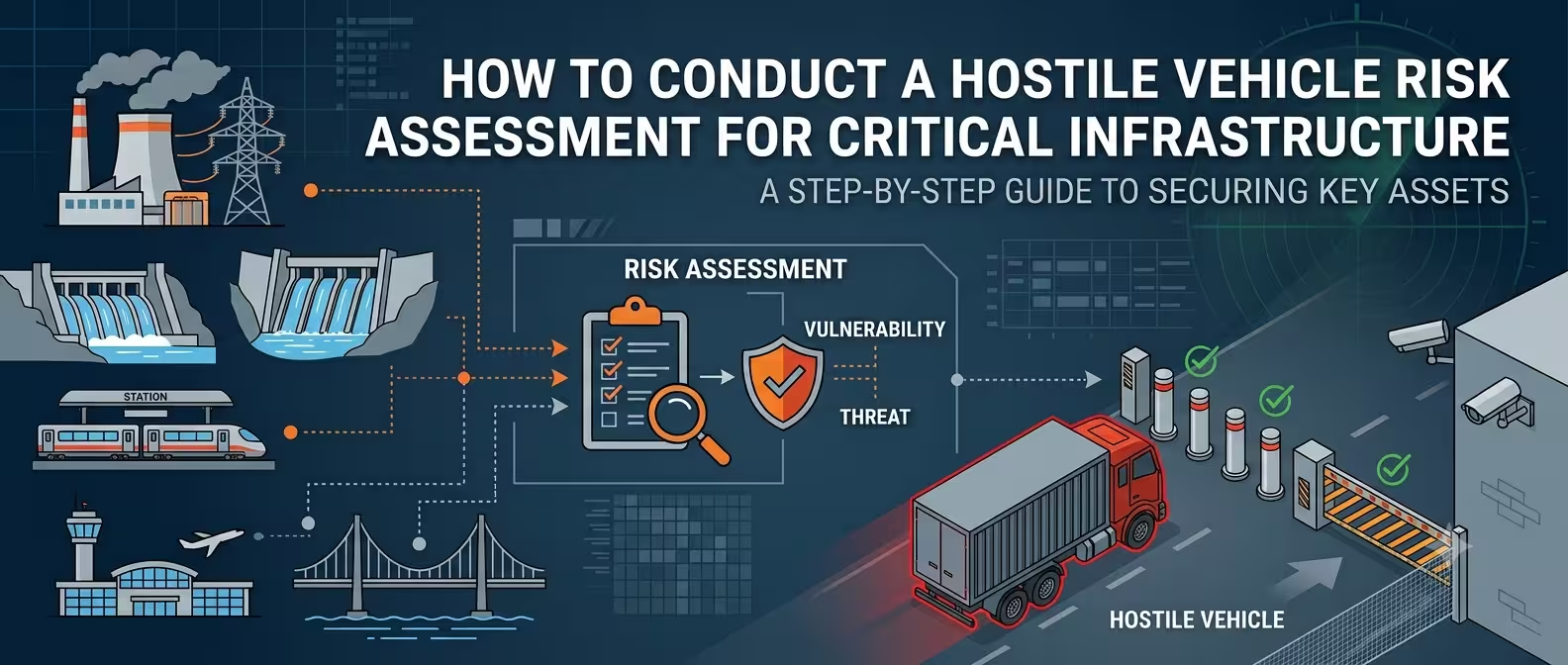
Key Factors to Consider Before Selecting Crash Rated Security Products

Selecting the right crash rated security product requires more than choosing the highest crash rating. Every facility has unique operational, environmental, and security requirements. Understanding these factors helps ensure the selected Hostile Vehicle Mitigation (HVM) solution delivers effective protection while supporting daily operations.

1. Security Risk Assessment

Begin by evaluating the potential vehicle threats facing your facility. Consider vehicle size, expected approach speeds, surrounding road layouts, pedestrian movement, and the level of protection required. High-risk facilities such as airports, government buildings, defence installations, and data centres typically require certified crash rated solutions tested against internationally recognised standards.

2. Required Crash Rating

Different facilities require different impact resistance levels. Products certified to standards such as ASTM F2656, PAS 68, and IWA 14-1 should be selected based on project specifications and risk assessments rather than cost alone.

3. Installation Environment

Evaluate available installation space, underground utilities, drainage systems, pavement conditions, and foundation requirements before selecting any crash rated product. Certain locations may have space limitations that influence whether bollards, road blockers, or crash rated gates are the most practical solution.

4. Traffic Flow Requirements

Determine whether the entrance requires unrestricted pedestrian movement, frequent vehicle access, emergency response capability, or controlled visitor entry. High-traffic facilities often require automated systems capable of fast operating cycles while maintaining maximum security.

5. Operational Frequency

Products installed at busy entrances may operate hundreds of times each day. Selecting equipment designed for the expected duty cycle helps minimise maintenance costs while improving long-term reliability.

6. Integration with Existing Security Systems

Modern HVM solutions should integrate seamlessly with existing security infrastructure, including access control systems, RFID readers, ANPR cameras, biometric authentication, CCTV surveillance, traffic signals, and visitor management software.

7. Environmental Conditions

Products should be suitable for local environmental conditions including temperature variations, heavy rainfall, dust, corrosion, flooding, or coastal environments. Material selection and protective coatings significantly influence long-term performance.

8. Maintenance Requirements

Evaluate maintenance accessibility, spare part availability, hydraulic or electromechanical components, and manufacturer support before finalising the product selection. Preventive maintenance planning reduces downtime and extends equipment life.

9. Future Expansion

Security requirements often evolve over time. Selecting scalable systems allows future integration with additional bollards, crash rated gates, fencing, access control technologies, or perimeter security upgrades without major infrastructure modifications.

10. Compliance with International Standards

Always verify that products have been independently tested and certified according to recognised international standards. Certification provides confidence that the product has demonstrated proven stopping capability under controlled testing conditions rather than relying solely on manufacturer claims.

Expert Recommendation

Rather than selecting products based only on appearance or price, organisations should perform a comprehensive security assessment considering threat level, operational requirements, future expansion, lifecycle costs, and compliance with recognised crash testing standards. A properly specified HVM solution provides significantly better long-term value, operational reliability, and security performance.

Common Mistakes to Avoid When Selecting Crash Rated Security Products

Choosing crash rated security products is a long-term investment in the protection of people, assets, and critical infrastructure. However, many projects focus only on product specifications or budget, overlooking important engineering and operational factors. These mistakes can reduce the effectiveness of a Hostile Vehicle Mitigation (HVM) system and lead to costly modifications after installation.

The following are some of the most common mistakes consultants, architects, contractors, and facility owners should avoid during the selection process.

Common Mistake Potential Impact Recommended Solution
Selecting products without certified crash testing Unverified vehicle stopping performance Choose products tested to ASTM F2656, PAS 68 or IWA 14-1 standards.
Ignoring site risk assessment Over-designed or under-protected installation Conduct a professional security risk assessment before product selection.
Considering only purchase price Higher maintenance and replacement costs Evaluate the total lifecycle cost, including maintenance and operational efficiency.
Insufficient foundation planning Reduced crash performance and installation delays Coordinate with civil engineers during the design phase.
Ignoring pedestrian movement Traffic congestion and poor user experience Balance security with pedestrian accessibility and emergency evacuation requirements.
Not planning for emergency operation Delayed emergency response Select systems with Emergency Fast Operation (EFO) or emergency override features where required.
Choosing products without future scalability Costly upgrades during facility expansion Select modular security systems that support future expansion and integration.

Think Beyond the Product

An effective hostile vehicle mitigation strategy is not created by installing a single security product. It is achieved by integrating crash rated bollards, road blockers, security gates, perimeter fencing, access control systems, surveillance technologies, and operational procedures into a comprehensive security plan.

Early collaboration between architects, consultants, civil engineers, security professionals, and manufacturers ensures that the selected solution meets operational requirements while complying with international security standards and project-specific risk levels.

Best Practice

Always select crash rated security products based on a combination of certified performance, project risk assessment, site conditions, operational requirements, maintenance expectations, and compliance with internationally recognised standards. A well-planned HVM solution delivers reliable protection while reducing long-term operational costs.

Common Mistakes to Avoid When Choosing Crash Rated Security Products

Selecting a crash rated security product is a long-term investment that directly affects the safety, operational efficiency, and compliance of a facility. While many organisations focus primarily on product cost, overlooking technical and site-specific requirements can result in inadequate protection, increased maintenance costs, and expensive modifications in the future.

Below are some of the most common mistakes made during the planning and procurement process—and how to avoid them.

Common Mistake Why It Matters Recommended Solution
Choosing products based only on price Low-cost products may not provide certified vehicle impact protection. Select products based on certified crash performance and lifecycle value.
Ignoring crash test certification Non-certified products may not perform during an actual vehicle attack. Specify products tested to ASTM F2656 or PAS 68 where applicable.
Incorrect foundation design Poor civil works can reduce barrier performance. Follow manufacturer foundation drawings and engineering recommendations.
Not considering future traffic flow Creates congestion and operational inefficiencies. Plan lane widths, vehicle turning radius and throughput requirements.
Selecting the wrong product type Different facilities require different HVM solutions. Perform a site risk assessment before product selection.
Ignoring maintenance requirements Unexpected downtime and increased operating costs. Evaluate maintenance intervals and availability of local support.
No integration planning Products may not work with access control or security systems. Ensure compatibility with RFID, ANPR, access control and CCTV.
Purchasing without consultant review Incorrect specifications may delay project approval. Consult security professionals during project planning.

Plan for the Entire Security Ecosystem

Crash rated bollards, road blockers, security gates, tyre killers, boom barriers, and access control systems should never be evaluated as standalone products. The most effective physical security strategy combines multiple layers of protection to reduce risk while maintaining operational efficiency.

For example, a data centre may require automatic crash rated bollards at the vehicle entrance, turnstiles for pedestrian access, CCTV surveillance, and RFID-based access control. Similarly, airports and government facilities often deploy a combination of road blockers, crash rated gates, perimeter fencing, and vehicle inspection areas to achieve comprehensive hostile vehicle mitigation.

Work with an Experienced Security Partner

Every project has unique operational, environmental, and security requirements. Working with an experienced manufacturer and system integrator helps ensure that the selected solution complies with international standards, integrates with existing infrastructure, and delivers reliable long-term performance.

Need Help Selecting the Right Crash Rated Security Solution?

Our specialists can help you evaluate site risks, recommend appropriate Hostile Vehicle Mitigation (HVM) products, and assist with project planning, technical specifications, and system integration for critical infrastructure, government facilities, airports, data centres, industrial sites, and commercial developments.

Talk to Our Security Experts

Frequently Asked Questions (FAQs)

1. What are crash rated security products?

Crash rated security products are engineered physical security systems designed to stop or slow unauthorized vehicles. These include crash rated bollards, road blockers, security gates, tyre killers and barriers that have been tested against international standards such as ASTM F2656, PAS 68 and IWA 14-1.

2. Which crash test standard is most commonly used?

The most widely recognised standards are ASTM F2656, PAS 68, IWA 14-1 and ISO 22343. The appropriate standard depends on project specifications, country regulations and security requirements.

3. How do I choose between crash rated bollards and road blockers?

Crash rated bollards are ideal for pedestrian areas, building entrances and public spaces where aesthetics and controlled access are important. Road blockers are better suited for high-security vehicle checkpoints requiring complete roadway protection and rapid operation.

4. Are automatic bollards better than fixed bollards?

It depends on operational requirements. Automatic bollards provide controlled vehicle access while maintaining high security, whereas fixed bollards offer permanent perimeter protection with minimal maintenance.

5. Which industries require crash rated security products?

These products are commonly used in airports, government facilities, defence establishments, embassies, data centres, power plants, oil & gas facilities, banking institutions, transportation hubs, critical infrastructure and commercial developments.

6. What factors should be considered before selecting a crash rated product?

Key considerations include vehicle threat level, crash certification, installation requirements, site layout, traffic flow, operating frequency, maintenance needs, environmental conditions and compliance with applicable security standards.

7. Why is ISO 22343 important for HVM projects?

ISO 22343 provides guidance for selecting, specifying and deploying Hostile Vehicle Mitigation (HVM) measures. It helps consultants and project teams choose appropriate vehicle security barriers based on threat assessments and operational requirements.

8. Can Secure Innovative help select the right HVM solution?

Yes. Secure Innovative provides consultation, site assessment and customised Hostile Vehicle Mitigation solutions including crash rated bollards, road blockers, tyre killers, crash rated gates, perimeter security and entrance control systems for critical infrastructure projects.


Secure Innovative WhatsApp Support