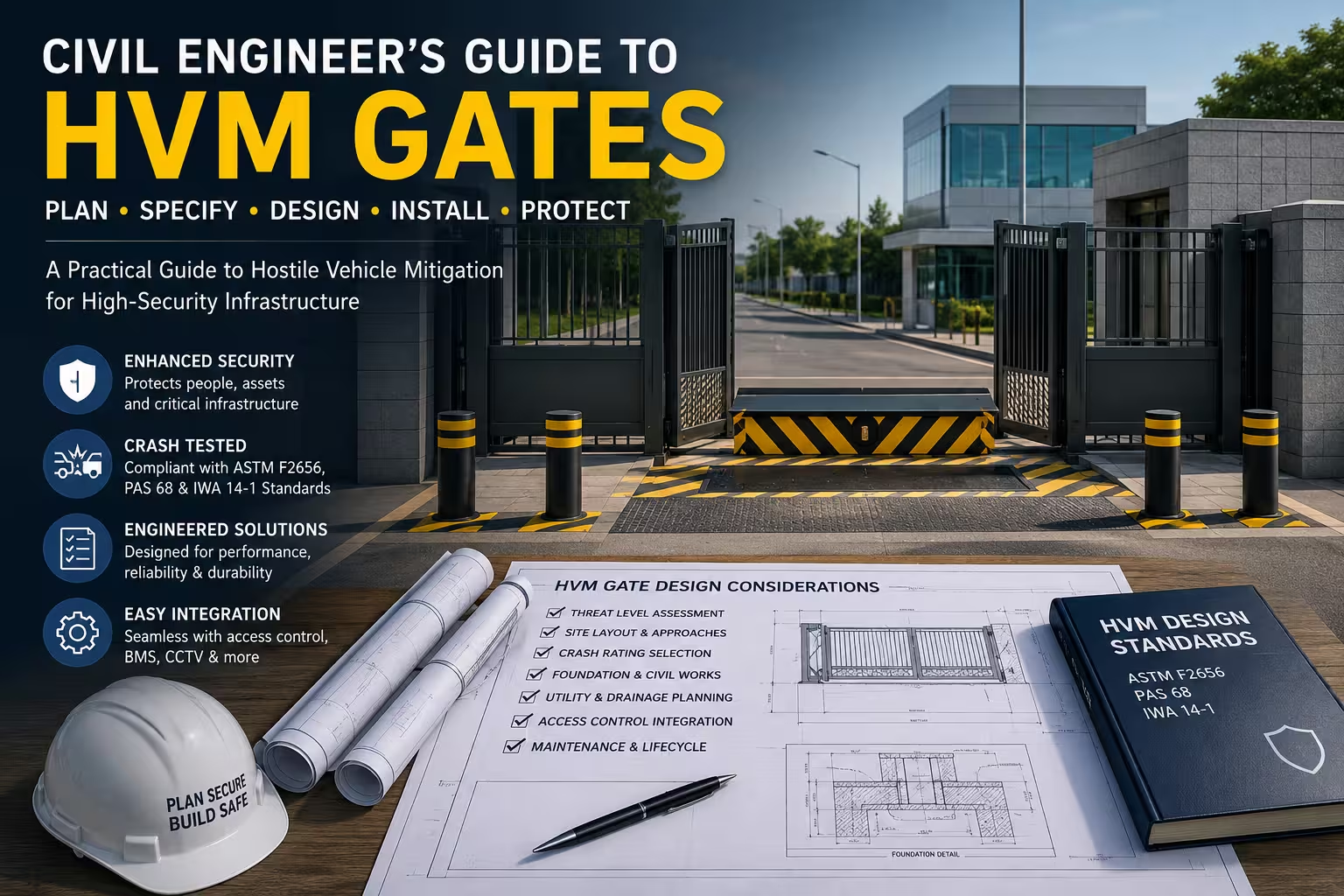
As urban infrastructure becomes more complex and security threats continue to evolve, civil engineers are increasingly involved in designing facilities that require advanced physical protection. Government buildings, airports, data centers, power plants, embassies, industrial facilities, and critical infrastructure all require carefully planned Hostile Vehicle Mitigation (HVM) systems.
Among these protective measures, crash rated HVM gates play a vital role by controlling vehicle access while providing certified resistance against vehicle-borne threats. Selecting the right gate requires more than choosing an opening mechanism—it involves understanding crash ratings, site layout, traffic flow, structural requirements, operational efficiency, and compliance with international testing standards.
This guide explains the engineering principles, design considerations, and best practices that civil engineers should evaluate before specifying crash rated gates for modern infrastructure projects.
Quick Answer
Hostile Vehicle Mitigation (HVM) Gates are crash-tested security gates designed to stop unauthorized or hostile vehicles while allowing controlled vehicle access. Civil engineers should evaluate crash ratings, structural foundations, traffic patterns, automation requirements, site constraints, and applicable standards such as ASTM F2656, PAS 68, and IWA 14-1 before selecting an HVM gate.
What are Hostile Vehicle Mitigation Gates?
Why Civil Engineers Need HVM Gates
Understanding Crash Ratings
ASTM F2656 vs PAS 68 vs IWA 14-1
Types of Crash Rated Gates
Foundation & Civil Requirements
Site Planning Considerations
Common Design Mistakes
Best Practices
Frequently Asked Questions
Why Civil Engineers Must Consider HVM Gates in Early Design Stages
One of the most common mistakes in security infrastructure projects is treating HVM gates as a late-stage add-on rather than a core civil design element. Crash-rated gates are not simply access control devices; they are structural security systems that interact with foundations, drainage, traffic circulation, utilities, and perimeter protection.
When HVM requirements are identified during the concept or schematic design stage, civil engineers can optimize foundation design, reduce rework, improve traffic flow, and avoid conflicts with underground services. Early coordination also helps achieve better compliance with project security objectives and reduces overall installation costs.
Key Coordination Areas for Civil Engineers
Foundation depth and reinforcement
Drainage and water management
Pavement and approach road design
Vehicle turning radius and stacking distance
Underground utilities and cable routing
Perimeter fence and wall integration
Emergency access and egress planning
Future maintenance accessibility
Foundation Design Considerations
Crash-rated gates transfer significant impact loads into the foundation system. The required foundation dimensions depend on the gate type, crash rating (K4, K8, or K12), soil conditions, and structural design methodology. Civil engineers should coordinate with the gate manufacturer to obtain foundation reaction loads, anchor details, and reinforcement requirements.
Drainage Is a Critical Design Factor
Poor drainage is one of the leading causes of operational problems in automated security gates. Water accumulation can affect hydraulic systems, electrical components, and foundation durability. Surface drainage slopes, trench drains, and cable duct sealing should be incorporated into the civil design from the beginning.
Traffic Flow and Safety
HVM gates should be positioned to provide adequate vehicle deceleration distance, inspection space, and queuing capacity. For high-security facilities such as data centers, power plants, embassies, and airports, engineers should evaluate approach geometry, lane separation, and emergency bypass requirements.
Integration with Perimeter Security
A crash-rated gate is only as effective as the surrounding perimeter. Civil engineers should ensure that fences, walls, bollards, and gate supports create a continuous protective line without weak points or bypass opportunities.
Design Tip
For critical infrastructure projects, coordinate the HVM gate layout before finalizing pavement, utility corridors, and drainage drawings. Early coordination typically reduces site modifications, installation delays, and long-term maintenance issues.
Types of HVM Gates Used in Civil Engineering Projects
Selecting the appropriate Hostile Vehicle Mitigation (HVM) gate depends on several engineering considerations, including available installation space, vehicle traffic volume, required security level, architectural requirements, and applicable project standards. Understanding the characteristics of each gate type helps civil engineers design safe, efficient, and future-ready access control systems.
1. Crash Rated Sliding Gates
Crash rated sliding gates move horizontally along a track or cantilever system and are ideal where wide vehicle entrances require reliable protection. These gates are commonly specified for industrial facilities, logistics hubs, data centers, airports, and critical infrastructure because they provide excellent perimeter security while occupying minimal operating space.
2. Crash Rated Swing Gates
Crash rated swing gates rotate inward or outward and are often selected for government facilities, embassies, military installations, and commercial developments. They are suitable where sufficient swing clearance is available and architectural appearance is an important project consideration.
3. Crash Rated Bi-Folding Gates
Bi-folding gates consist of hinged gate leaves that fold during operation, allowing significantly faster opening and closing compared to conventional swing gates. They are particularly effective for sites requiring rapid vehicle throughput while working within limited installation space.
4. Road Blockers
Road blockers provide one of the highest levels of hostile vehicle mitigation by creating a reinforced barrier capable of stopping unauthorized vehicles at entry points. They are widely used at military bases, power plants, government facilities, embassies, and other high-security locations.
5. Crash Rated Bollards
Crash rated bollards protect pedestrian areas, building entrances, and sensitive assets without restricting normal pedestrian movement. They are frequently installed around commercial buildings, airports, corporate offices, stadiums, and public infrastructure.
How Civil Engineers Select the Right HVM Gate
During project planning, civil engineers should evaluate operational requirements alongside structural and security considerations. The following factors are commonly assessed before selecting an HVM solution:
Required crash rating (ASTM F2656, PAS 68 or IWA 14-1)
Site risk assessment and security objectives
Available installation space and foundation design
Traffic volume and vehicle classifications
Opening speed and operational frequency
Emergency vehicle access requirements
Integration with access control and surveillance systems
Power supply and backup requirements
Environmental and climatic conditions
Maintenance accessibility and lifecycle cost
Compliance with project specifications and local regulations
Key Design Considerations When Specifying HVM Gates
Selecting the right Hostile Vehicle Mitigation (HVM) gate involves more than choosing a crash rating. Civil engineers should evaluate site conditions, vehicle movement, structural requirements, operational needs, and future maintenance to ensure long-term performance and regulatory compliance.
Design Factor
Engineering Consideration
Threat Assessment
Identify the required crash rating based on project risk analysis and applicable security standards.
Site Layout
Evaluate available space, road geometry, turning radius, and approach distance before selecting sliding, swing, or bi-folding gates.
Foundation Design
Design reinforced concrete foundations capable of transferring impact loads safely into the surrounding structure.
Select an opening width suitable for expected vehicle types while maintaining required security levels.
Power & Controls
Provide reliable electrical supply, backup power, PLC-based controls, and emergency override functionality.
Access Control
Plan integration with RFID, ANPR, biometric authentication, visitor management, and centralized security systems.
Safety Systems
Include photocells, safety edges, warning lights, emergency stop switches, and obstacle detection devices.
Environmental Conditions
Account for wind loads, corrosion, drainage, temperature variations, and local environmental exposure.
Maintenance Access
Ensure sufficient space for inspection, servicing, repairs, and replacement of mechanical and electrical components.
Key Design Considerations for Civil Engineers When Specifying HVM Gates
Selecting a Hostile Vehicle Mitigation (HVM) gate involves more than choosing a crash rating. Civil engineers must evaluate site conditions, structural requirements, operational needs, and integration with surrounding infrastructure to ensure long-term performance, safety, and regulatory compliance.
1. Threat & Risk Assessment
Identify the potential vehicle threat, required crash rating (K4, K8, K12 or equivalent), traffic profile, and the level of protection needed for the facility.
2. Foundation & Structural Design
The gate foundation should be designed to safely transfer impact loads to the surrounding structure while considering soil conditions, reinforcement, underground utilities, and drainage.
3. Available Installation Space
Evaluate whether sliding, swing, cantilever, or bi-folding gates are suitable based on site constraints, vehicle circulation, and available operating space.
4. Traffic Flow Requirements
Determine expected vehicle volume, opening frequency, peak-hour traffic, and emergency access requirements to select an appropriate gate configuration.
5. Access Control Integration
Ensure compatibility with RFID, ANPR, biometric authentication, visitor management systems, security checkpoints, and centralized control platforms.
6. Environmental Conditions
Consider wind loads, corrosion resistance, temperature variations, dust, humidity, coastal environments, and seismic requirements during system selection.
7. Maintenance Accessibility
Provide sufficient clearance for routine inspection, preventive maintenance, emergency servicing, and replacement of mechanical or electrical components.
8. Compliance & Safety Standards
Verify that the proposed solution aligns with applicable project specifications and internationally recognized crash testing and safety standards where required.
Building Safer Infrastructure with Proper HVM Gate Planning
Selecting the right Hostile Vehicle Mitigation (HVM) gate involves more than choosing a crash rating. Civil engineers must evaluate vehicle approach speed, foundation requirements, site constraints, traffic flow, emergency access, utility coordination, and applicable security standards during the planning stage.
Integrating HVM gates early in the project lifecycle helps reduce redesign costs, simplifies installation, and improves long-term operational efficiency. Whether the project involves airports, data centers, power plants, government facilities, industrial sites, or commercial campuses, properly planned HVM systems contribute to safer and more resilient infrastructure.
Secure Innovative works closely with consultants, architects, EPC contractors, and civil engineers to provide technical guidance, customized engineering support, and integrated HVM gate solutions tailored to project requirements.
Contact our engineering team for project consultation, technical specifications, CAD drawings, and customized HVM gate solutions.
Frequently Asked Questions (FAQs)
1. What is an HVM gate?
An HVM (Hostile Vehicle Mitigation) gate is a high-security gate designed to stop or slow unauthorized vehicle intrusion while allowing controlled access to protected facilities such as airports, data centers, government buildings, power plants, and industrial sites.
2. Which crash rating should I choose for an HVM gate?
The appropriate crash rating depends on the site's risk assessment, vehicle threat level, applicable regulations, and operational requirements. Common ratings include K4, K8, K12 and equivalent ASTM F2656, PAS 68, or IWA 14-1 classifications.
3. What industries use crash-rated HVM gates?
HVM gates are widely used at airports, military facilities, embassies, government buildings, power plants, oil & gas facilities, data centers, ports, logistics hubs, and other critical infrastructure.
4. Can HVM gates integrate with access control systems?
Yes. Modern HVM gates can integrate with RFID, biometric authentication, ANPR, smart cards, visitor management systems, CCTV, and centralized security platforms.
5. What factors should civil engineers consider when specifying HVM gates?
Civil engineers should evaluate crash rating requirements, foundation design, clear opening width, vehicle traffic, site layout, drainage, utility routing, maintenance access, and integration with the overall security infrastructure.
6. Are HVM gates suitable for high-traffic entrances?
Yes. Depending on the gate type and operating mechanism, crash-rated sliding, swing, or bi-folding gates can support frequent operation while maintaining a high level of physical security.