
Modern facilities require more than traditional locks and keys to protect employees, visitors, assets, and sensitive information. As organizations strengthen their physical security strategies, access control systems have become a critical part of facility design.
Two of the most commonly specified entrance control solutions are Mantraps and Turnstiles. While both systems help regulate pedestrian movement and improve security, they serve different purposes and are designed for different threat levels.
Choosing between a Mantrap and a Turnstile depends on factors such as security requirements, pedestrian traffic volume, regulatory compliance, and operational efficiency.
This guide explains the differences between Mantraps and Turnstiles, their applications, advantages, limitations, and how to determine which solution is best suited for your facility.
What Is a Mantrap?
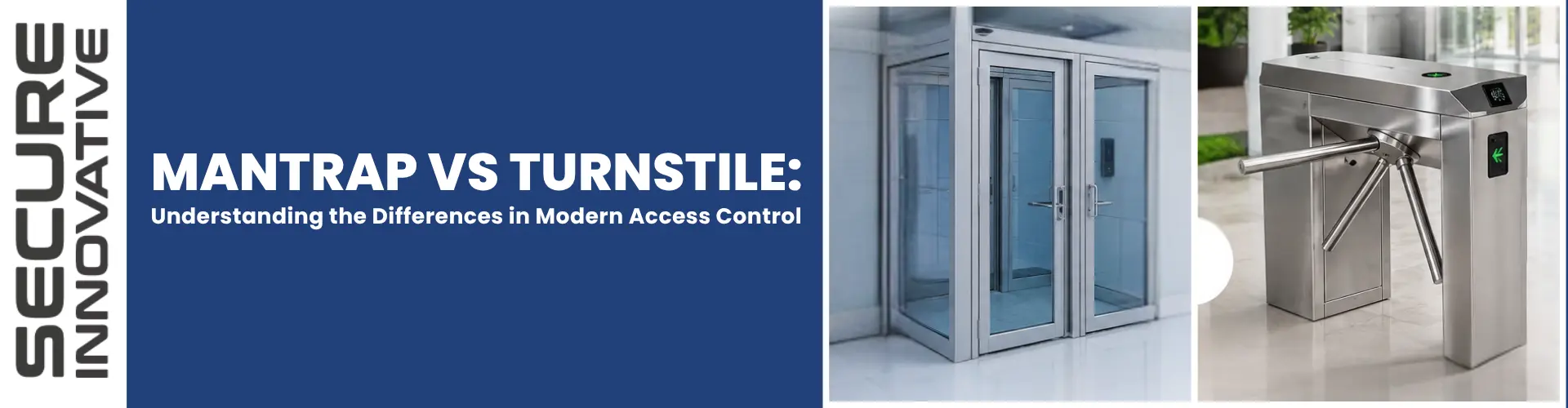
A Mantrap is a high-security access control system consisting of two interlocking doors that create a secure chamber between the public area and a protected space.
Only one door can open at a time. After a person enters through the first door, it closes and locks before the second door is permitted to open.
During this process, the system may verify credentials using access cards, PIN codes, facial recognition, fingerprint readers, iris scanners, or other authentication methods.
Mantraps are specifically designed to prevent unauthorized access, tailgating, piggybacking, and security breaches in critical facilities.
How a Mantrap Works
- User presents credentials.
- First door unlocks and allows entry into the chamber.
- First door closes and locks.
- Identity verification is completed.
- Second door unlocks if access is approved.
- User enters the secured area.
Common Applications of Mantraps
- Data Centers
- Banks and Financial Institutions
- Government Buildings
- Defense Facilities
- Research Laboratories
- Pharmaceutical Manufacturing Plants
- Critical Infrastructure Sites
- High-Security Corporate Offices
What Is a Turnstile?
A Turnstile is a pedestrian access control system that allows people to pass through one at a time while restricting unauthorized entry.
Turnstiles can be mechanical or automated and are commonly integrated with access control systems such as RFID cards, QR codes, mobile credentials, biometrics, or ticketing systems.
Unlike a Mantrap, a Turnstile is designed primarily to manage pedestrian flow efficiently while providing a moderate to high level of security.
Common Types of Turnstiles
- Tripod Turnstiles
- Full-Height Turnstiles
- Half-Height Turnstiles
- Optical Turnstiles
- Speed Gates
Common Applications of Turnstiles
- Corporate Buildings
- Metro Stations
- Airports
- Educational Institutions
- Sports Stadiums
- Business Parks
- Manufacturing Facilities
- Commercial Complexes
Mantrap vs Turnstile — Comparison Table
| Parameter | Mantrap | Turnstile |
|---|---|---|
| Security Level | Very High | Medium to High |
| Entry Method | Two-door secured chamber | Rotating barrier or speed gate |
| Tailgating Prevention | Excellent | Moderate |
| Piggybacking Prevention | Excellent | Moderate |
| User Throughput | Lower | Higher |
| Authentication | Multi-factor capable | Typically single authentication |
| Physical Barrier | Fully enclosed | Open passage |
| Best Application | High-security environments | High-traffic environments |
| Typical Users | One person at a time | Continuous pedestrian flow |
| Cost | Higher | Lower to Moderate |
When Should You Choose a Mantrap?
1. Maximum Security Is Required
A Mantrap is the preferred solution when protecting critical assets, sensitive information, or restricted operational areas.
2. Tailgating Must Be Eliminated
Because only one person can enter the chamber at a time, Mantraps provide superior protection against unauthorized entry.
3. Regulatory Compliance Is Important
Many financial, government, pharmaceutical, and data center facilities require strict access control measures.
4. Individual Verification Is Required
Mantraps allow organizations to verify every person entering before access is granted.
When Should You Choose a Turnstile?
1. High Pedestrian Traffic Exists
Turnstiles are designed to process large numbers of users efficiently.
2. Fast Entry and Exit Are Important
Corporate offices, transit hubs, and commercial buildings often require rapid user throughput.
3. Moderate Security Is Sufficient
Turnstiles provide controlled access while maintaining operational convenience.
4. Budget Efficiency Is a Priority
Turnstiles generally require lower investment than a fully integrated Mantrap system.
Can Mantraps and Turnstiles Work Together?
Yes. Many modern facilities implement a layered security strategy.
For example, Turnstiles may control access at the building entrance, while a Mantrap protects highly sensitive areas such as data halls, control rooms, laboratories, or executive zones.
This approach balances operational efficiency with enhanced security protection.
Final Thoughts
Both Mantraps and Turnstiles play an important role in modern access control systems.
If preventing unauthorized access and tailgating is your highest priority, a Mantrap provides the strongest level of pedestrian security.
If managing large volumes of people efficiently is the primary objective, a Turnstile may be the better choice.
Many organizations ultimately use both technologies together to create a comprehensive and layered security solution.
Frequently Asked Questions
What is the main difference between a mantrap and a turnstile?
A mantrap is a fully enclosed, two-door interlocking chamber that verifies one person at a time, offering very high security. A turnstile is an open rotating or gated barrier that also allows one person through at a time, but with lower security and much higher pedestrian throughput.
Is a mantrap more secure than a turnstile?
Yes. A mantrap provides excellent protection against tailgating and piggybacking because only one person can be verified inside the enclosed chamber at a time. Turnstiles offer moderate to high security but are more vulnerable to tailgating, especially half-height or tripod models.
Which is better for high pedestrian traffic, a mantrap or a turnstile?
Turnstiles are better suited for high pedestrian traffic because they process users quickly with a single authentication step. Mantraps have lower throughput since each person must be individually verified inside a secured chamber before the next person can enter.
Can mantraps and turnstiles be used together?
Yes. Many facilities use a layered approach — turnstiles control access at the building entrance to manage general pedestrian flow, while mantraps protect highly sensitive areas such as data halls, control rooms, or executive zones.
Which industries typically use mantraps instead of turnstiles?
Mantraps are common in data centers, banks, government buildings, defense facilities, research laboratories, and pharmaceutical plants, where individual verification and zero tolerance for tailgating are required.
Need a Mantrap or Turnstile Solution for Your Facility?
Secure Innovative provides advanced Mantrap Systems, Turnstiles, Speed Gates, and Access Control Solutions for data centers, government facilities, corporate offices, airports, and critical infrastructure projects.
Explore Mantrap Solutions


