
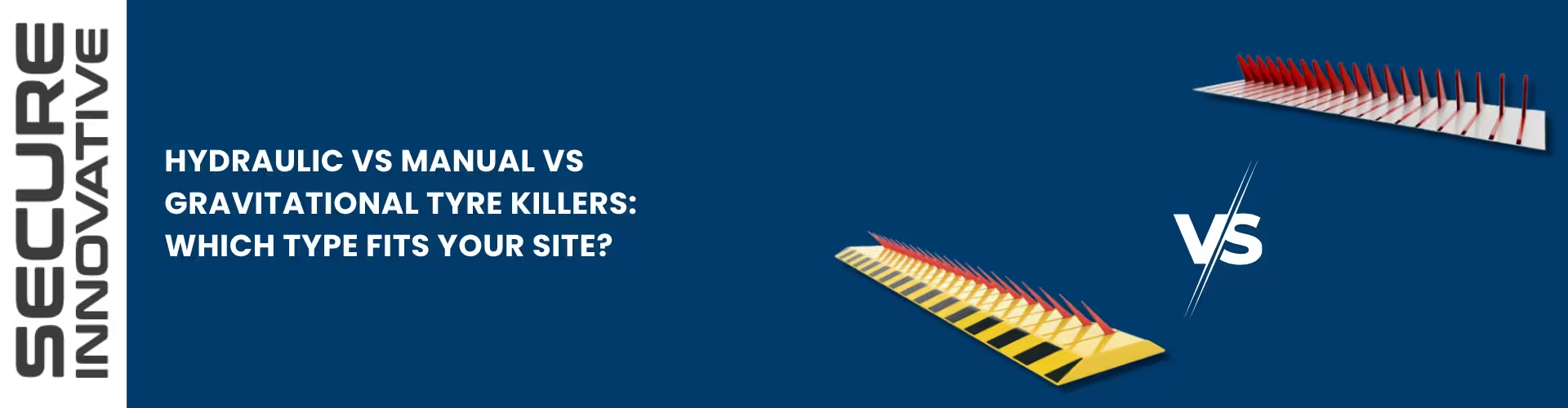
Hydraulic vs Manual vs Gravitational Tyre Killers: Which Type Fits Your Site?
Quick answer: "Tyre killer" and "spike barrier" refer to the same product — the real choice is between operation types. A hydraulic tyre killer with Emergency Fast Operation (EFO) deploys in ~1 second — best for high-security sites. Electro-mechanical models offer reliable automation at lower cost. Manual and gravitational models need no power supply — best for low-traffic or budget-constrained checkpoints.
"Tyre killer" and "spike barrier" are two names for the same vehicle-denial system — a row of retractable steel spikes that puncture the tires of an unauthorized vehicle. Rather than comparing names, the real decision to make is between the operation types available, since each suits a different site, budget, and response-time requirement.
1. Hydraulic Tyre Killers
Hydraulic tyre killers use a hydraulic power unit to deploy the spikes with maximum force and speed. When equipped with Emergency Fast Operation (EFO), they can open in as little as 1 second — the fastest response time among all tyre killer types.
Key Features
- Fastest deployment — as low as 1 second with EFO
- Heavy-duty steel spikes engineered to damage tires, suspension, and axles
- Surface-mounted design for straightforward installation
- Hot-dip galvanized or RAL-colour painted steel construction
- Ideal for defense, critical infrastructure, and high-security parking lots
2. Electro-Hydraulic / Electro-Mechanical Tyre Killers
These models combine an electric motor with a hydraulic or mechanical drive system, operating in one-way or two-direction configurations to stop unauthorized intrusion. They are typically shallow-mount, making installation less disruptive than deep-foundation hydraulic systems.
Key Features
- Automated one-way or two-direction operation
- Shallow-mount installation, lower civil work requirement
- Reliable automation at a moderate cost point
- Suitable for defense, critical infrastructure, and parking lots
3. Manual Tyre Killers
Manual tyre killers are operated by a physical lever rather than electric or hydraulic power, giving one-way or two-direction traffic control without requiring a continuous power supply.
Key Features
- Lever-operated, no electrical or hydraulic power needed
- Shallow-mount installation
- Low upfront and maintenance cost
- Reliable backup option where power supply is inconsistent
4. Gravitational Tyre Killers
Gravitational tyre killers rely on gravity to return the spike plate to its resting position after deployment, offering a simple, low-maintenance one-way vehicle deterrent.
Key Features
- Gravity-return mechanism, minimal moving parts
- One-way traffic control
- Low cost and low maintenance
- Suitable for light-duty checkpoints and budget-constrained sites
Comparison Table
| Type | Power Source | Deployment Speed | Mounting | Best For |
|---|---|---|---|---|
| Hydraulic (with EFO) | Hydraulic power unit | ~1 second | Surface-mounted | Defense, critical infrastructure |
| Electro-Hydraulic / Electro-Mechanical | Electric motor + hydraulic/mechanical drive | Fast, automated | Shallow-mount | Critical infrastructure, parking lots |
| Manual | Physical lever | Operator-dependent | Shallow-mount | Low-traffic checkpoints, backup systems |
| Gravitational | Gravity return | Operator-dependent | Surface-mounted | Light-duty, budget-constrained sites |
Which Type Should You Choose?
Choose a hydraulic tyre killer with EFO where instant response to a hostile vehicle threat is critical — defense bases, embassies, and critical infrastructure. Choose an electro-mechanical model for reliable, automated control at a moderate budget. Choose a manual or gravitational model where power supply is unreliable, traffic is light, or budget is the primary constraint.
Frequently Asked Questions
Are tyre killers and spike barriers the same product?
Yes. Tyre killer and spike barrier are two names for the same type of vehicle-denial system that uses retractable spikes to puncture tires. The real differences to consider are between the operation types: hydraulic, electro-mechanical, manual, and gravitational.
What is the fastest type of tyre killer?
A hydraulic tyre killer equipped with Emergency Fast Operation (EFO) is the fastest, deploying in about 1 second. This makes it suitable for high-security sites needing instant response to a threat.
Which tyre killer type is most cost-effective?
Manual and gravitational tyre killers are generally the most cost-effective since they don't require electric or hydraulic power units, making them suitable for sites with budget constraints or no power access.
What is the difference between hydraulic and electro-mechanical tyre killers?
Hydraulic tyre killers use a hydraulic power unit for very fast, high-force deployment, ideal for defense and critical infrastructure. Electro-mechanical tyre killers use an electric motor mechanism, offering reliable automation at a somewhat lower cost and deployment speed than hydraulic systems.
Where is a manual tyre killer typically used?
Manual tyre killers, operated by a physical lever, are typically used at low-traffic checkpoints, small facilities, or as a backup system where continuous power supply isn't guaranteed.
Need Help Choosing the Right Tyre Killer?
Secure Innovative manufactures hydraulic, electro-mechanical, manual, and gravitational tyre killers / spike barriers for defense, critical infrastructure, and commercial sites.
Talk to Our Security Experts


