
K4 vs K8 vs K12 Bollards: Crash Rating Differences Explained
Published by Secure Innovative | Updated: July 1, 2026
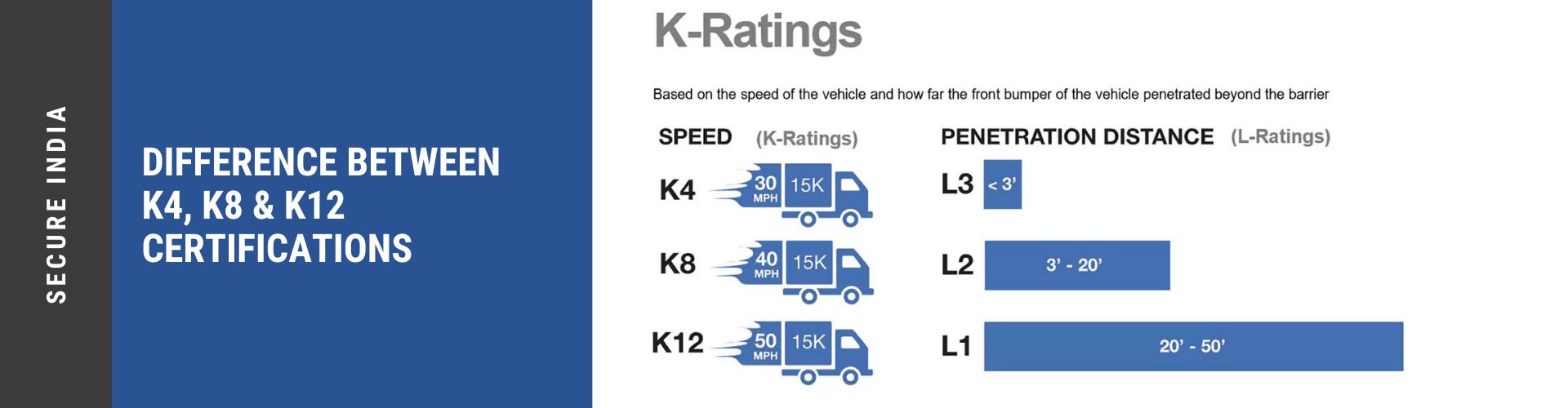
Quick answer: K4, K8, and K12 are U.S. Department of State crash ratings for Hostile Vehicle Mitigation (HVM) bollards. They all test a 15,000 lb (6,800 kg) vehicle, but at different speeds — K4 at 30 mph, K8 at 40 mph, and K12 at 50 mph. The higher the number, the more impact energy the bollard is certified to stop. K4 = M30, K8 = M40, K12 = M50 under the equivalent ASTM F2656 standard.
HVM (Hostile Vehicle Mitigation) bollards are classified under crash-rating certifications that define exactly how much vehicle impact they can withstand. Among these, K4, K8, and K12 are the ratings most commonly specified by security consultants, architects, and procurement teams. This guide breaks down what each rating actually means, how they compare, and how to choose the right one for your site.
Where Do K4, K8, K12 Ratings Come From?
These ratings originate from U.S. Department of State crash-test standards, developed to measure how well a physical barrier stops a vehicle-borne threat. The same test conditions were later adopted into ASTM F2656, the international standard now used to certify crash-rated barriers worldwide — which is why you will see K-ratings and M-ratings referenced interchangeably.
K4 vs K8 vs K12 — Full Comparison Table
| Rating | ASTM Equivalent | Vehicle Weight | Impact Speed | Typical Application |
|---|---|---|---|---|
| K4 | M30 | 15,000 lb (6,800 kg) | 30 mph (48 km/h) | Corporate offices, parking areas, low-risk perimeters |
| K8 | M40 | 15,000 lb (6,800 kg) | 40 mph (64 km/h) | Commercial complexes, IT parks, medium-risk sites |
| K12 | M50 | 15,000 lb (6,800 kg) | 50 mph (80 km/h) | Embassies, airports, defense installations, high-security zones |
Vehicle Speed & Impact Energy
- K4 (M30): Stops a 15,000 lb vehicle travelling at 30 mph.
- K8 (M40): Stops a 15,000 lb vehicle travelling at 40 mph.
- K12 (M50): Stops a 15,000 lb vehicle travelling at 50 mph.
Because kinetic energy increases with the square of speed, a K12-rated bollard absorbs significantly more impact energy than a K4-rated bollard — not just proportionally more, which is why K12 systems require deeper foundations and heavier steel cores.
Penetration Distance
Effective HVM bollards are certified not only to stop the vehicle but also to limit how far it travels past the barrier line after impact — known as penetration distance. This figure varies by specific product and test report, so always request the certified penetration distance for the exact model you are specifying, rather than assuming a single number applies across all K-ratings.
Which Rating Suits Which Site?
- K4: Low-risk zones — small corporate offices, retail parking areas, residential gated communities.
- K8: Medium-risk zones — commercial complexes, IT parks, logistics hubs, banking branches.
- K12: High-security zones — embassies, airports, government buildings, defense installations, data centers.
Explore Secure Innovative's Crash Rated Bollards range or browse Fixed Bollards and Automatic Bollards to compare models by rating.
Cost vs Security: Choosing the Right Rating
Higher ratings generally cost more — deeper foundations, thicker steel, and additional testing all add to the price. Choose a rating based on a documented risk profile, not budget alone. Over-specifying (installing K12 where K4 is sufficient) increases project cost unnecessarily, while under-specifying leaves a site genuinely exposed to vehicle-borne threats.
Conclusion
Selecting the right crash rating is a risk-based decision, not a one-size-fits-all choice. Work with manufacturers who provide proper crash-test documentation and compliance certificates for every model, so the rating on paper matches the protection installed on site.
Frequently Asked Questions
What does K4, K8, and K12 mean for bollards?
K4, K8, and K12 are U.S. Department of State crash-test ratings that classify how much impact energy a bollard can stop. K4 stops a 15,000 lb vehicle at 30 mph, K8 at 40 mph, and K12 at 50 mph. Higher numbers mean greater impact energy absorption.
What is the difference between K4/K8/K12 and M30/M40/M50 ratings?
K4/K8/K12 are the original U.S. Department of State ratings, while M30/M40/M50 are the equivalent ASTM F2656 ratings for the same test conditions — K4 = M30, K8 = M40, K12 = M50.
Which bollard rating do I need for my site?
It depends on your site's risk level: K4 (M30) for low-risk sites like offices and parking areas, K8 (M40) for medium-risk sites like commercial complexes, and K12 (M50) for high-security sites like embassies and defense installations. A site-specific vulnerability assessment gives the most accurate recommendation.
How much penetration distance do certified bollards allow?
Penetration distance — how far a vehicle travels past the barrier after impact — is certified per product and test report. Always request the exact figure for the specific model rather than assuming one number applies to all ratings.
Are K12 bollards always the best choice?
Not necessarily. K12 offers the highest protection but costs more and needs deeper foundations. Match the rating to a documented threat assessment for your site rather than defaulting to the highest rating available.
Need Help Choosing the Right Bollard Rating?
Secure Innovative manufactures certified K4, K8, and K12 crash-rated bollards, barriers, road blockers, and gates for corporate, commercial, and high-security sites.
Talk to Our Security Experts


